
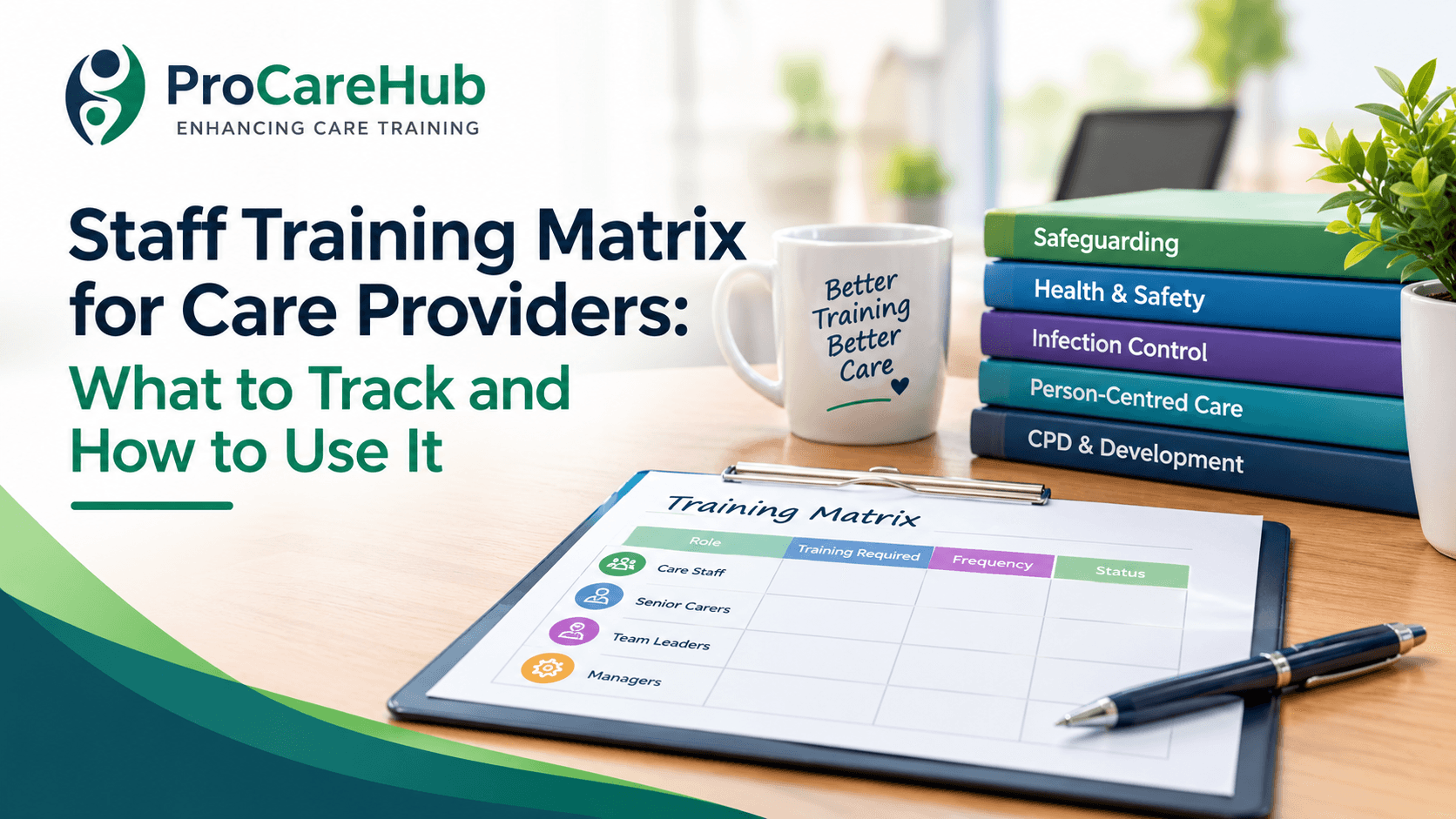
Staff Training Matrix for Care Providers: What to Track and How to Use It
By ProCare Hub Team
Keeping staff training organised is an essential part of running a safe and well-managed care service. For care home managers, domiciliary care providers and supported living managers, knowing who has completed their training, which courses need refreshing and where further support is required can quickly become difficult without a clear system.
A staff training matrix provides a practical way to bring this information together. Instead of searching through individual files, certificates and spreadsheets, managers can use one central record to monitor training requirements, identify gaps and plan staff development.
However, a training matrix should do more than record course completion dates. Used properly, it can help providers understand whether their workforce has the knowledge and skills needed to deliver safe, person-centred care.
In this guide, we explain what a staff training matrix is, what information it should contain and how care providers can use one effectively.
What Is a Staff Training Matrix?
A staff training matrix is a structured record showing the training requirements and learning progress of employees within an organisation.
It typically lists staff members against relevant training topics, allowing managers to see which courses have been completed, which are outstanding and which require review or renewal.
For example, a domiciliary care provider might use a training matrix to monitor safeguarding, infection prevention and control, moving and handling, medication training and other learning requirements relevant to individual roles.
A care home may also need to track additional training linked to the needs of residents, such as dementia awareness, nutrition and hydration, or specific clinical support responsibilities.
The exact requirements will depend on the service, the duties staff perform, the needs of people receiving care and the relevant legislation and guidance.
A training matrix can be maintained using a spreadsheet, workforce management software or a dedicated learning management system. The important thing is that the information is accurate, accessible to authorised staff and regularly reviewed.
Why Do Care Providers Need a Staff Training Matrix?
Managing training through scattered documents or memory alone can make it difficult to identify outstanding requirements. A structured matrix gives managers a clearer overview of their workforce's learning needs.
1. Monitor training completion
A training matrix allows managers to see whether employees have completed the learning required for their roles.
This is particularly useful when managing larger teams, multiple locations, agency staff or employees working different shifts.
2. Identify outstanding or overdue training
When training records are reviewed regularly, managers can identify incomplete learning and upcoming renewal dates before they become urgent issues.
This makes it easier to arrange courses, allocate time for learning and follow up with employees who need support.
3. Support regulatory compliance
For providers regulated by the Care Quality Commission (CQC), staff must receive appropriate training, support, supervision and professional development for their roles
.
Regulation 18 of the Health and Social Care Act 2008 (Regulated Activities) Regulations 2014 sets out these staffing requirements.
A well-maintained training matrix can help providers monitor learning requirements and demonstrate how they manage staff development.
A matrix alone does not guarantee compliance, but it can provide useful evidence alongside training certificates, competency assessments, supervision records and other relevant documentation.
Read the CQC's guidance on Regulation 18: Staffing.
4. Improve workforce planning
Training records can reveal patterns across a team. For example, several employees may need additional medication training, or a new service may require staff to develop skills in supporting people with particular needs.
Identifying these patterns helps managers plan group training, arrange individual support and budget for future learning.
5. Support safer, more consistent care
Staff training should reflect the needs of the people receiving care.
By tracking required learning and identifying areas where further development is needed, providers can take a more organised approach to helping staff carry out their responsibilities safely and confidently.
What Should a Staff Training Matrix Include?
A useful training matrix should contain enough information to help managers make decisions without becoming unnecessarily complicated.
The following fields provide a practical starting point.
Employee details
Include the employee's name, job title, team or service location and, where useful, their start date.
These details help managers identify who needs particular training and whether requirements differ between roles.
Access to personal information should be restricted to authorised individuals.
Required training topics
List the training relevant to each role. Depending on the service and employee's responsibilities, this may include:
- Safeguarding adults and, where relevant, safeguarding children.
- Health and safety.
- Fire safety.
- Infection prevention and control.
- Moving and handling.
- Medication management, where applicable.
- Mental capacity and consent.
- Equality, diversity and inclusion.
- Learning disability and autism training appropriate to the role.
- First aid or emergency response training where required.
- Service-specific training and practical competencies.
This list is illustrative rather than universal. Providers should establish requirements using current guidance, relevant legislation, risk assessments, job responsibilities and the needs of people using the service.
Skills for Care provides a useful reference in its statutory and mandatory training guidance for adult social care employers.
Training completion dates
Record when each employee completed the relevant training.
This provides a clear history of learning and helps managers distinguish between completed and outstanding requirements.
Where a course includes a certificate, retain the certificate or a suitable record of the evidence in the employee's training file.
Renewal or review dates
Record the next renewal or review date where applicable.
Not every course has the same renewal period, and there is no single timetable that automatically applies to every training topic and care role.
Managers should follow relevant legal or professional requirements, current guidance, provider policies and the nature of the training. Practical competencies may also need reassessment even when a course certificate remains valid.
Competency assessment results
Where practical competence needs to be assessed, record the assessment date, outcome and any further action required.
For example, an employee may have completed medication training but still require a practical competency assessment before undertaking medication-related duties independently.
The matrix can flag the assessment status, while the detailed assessment form is retained separately.
Outstanding actions
Include a field for follow-up actions, such as booking a course, arranging supervised practice or completing a competency reassessment.
Assign responsibility and a target date so that identified gaps are not left unresolved.
How to Create a Staff Training Matrix Step by Step
Care providers do not need an unnecessarily complicated system to get started. A straightforward process can make training easier to manage.
Step 1: Identify the requirements for each role
Start by listing the roles within your service and determining the training each role requires.
A registered manager, care worker, kitchen employee and maintenance worker may have different learning requirements.
Consider the needs of people receiving care, the duties performed by each employee, relevant guidance and any specific risks associated with the service.
Avoid assuming that every employee needs exactly the same training.
Step 2: Audit existing training records
Review the training information already available.
Check certificates, completion dates, induction records, competency assessments and other relevant evidence.
Identify missing information and distinguish between training that has not been completed and training for which evidence is simply unavailable.
Where records are incomplete, follow up with the employee or training provider rather than automatically assuming that the training was never completed.
Step 3: Build the matrix
Create a spreadsheet or use an appropriate digital system.
Enter employee details and list the relevant training topics. Record the available completion dates, renewal or review dates, assessment outcomes and outstanding actions.
Use consistent status labels, such as:
- Complete: The required learning has been completed and the necessary evidence is available.
- Due soon: A renewal, review or reassessment is approaching.
- Outstanding: Required training or assessment has not been completed.
- Action required: Further evidence, support or competency assessment is needed.
Define what each status means within your organisation so that managers use the system consistently.
Step 4: Prioritise gaps according to risk
Not every outstanding item presents the same level of risk.
A missing competency that could affect someone's immediate safety requires prompt action. Other training needs may be scheduled according to their deadlines, the employee's duties and the needs of the service.
Where necessary, put appropriate interim safeguards in place. An employee should not undertake duties independently if they have not demonstrated the competence required to perform them safely.
Step 5: Arrange and record training
Once priorities are clear, arrange suitable learning activities.
These may include online courses, classroom sessions, practical demonstrations, supervised practice or individual coaching.
Record completion and retain the relevant evidence. If a practical assessment is required, make sure the employee's competence is assessed rather than relying solely on course attendance.
Step 6: Review the matrix regularly
A training matrix should be a working document, not a spreadsheet that is updated only before an inspection.
Review it at planned intervals and whenever relevant changes occur, such as a new employee joining, a role changing, a new service being introduced or a person's care needs creating additional staff training requirements.
Regular reviews help managers identify emerging gaps and keep the information useful.
Common Mistakes to Avoid
Even a well-designed training matrix can become ineffective if it is not maintained properly.
Treating certificates as proof of competence
A certificate can demonstrate that a course was completed, but it does not necessarily show that an employee can apply the learning correctly in practice.
Use appropriate observations, assessments and supervision to check competence where required.
Using the same training requirements for everyone
A generic list may overlook important differences between roles.
A member of staff administering medication, for example, may need additional role-specific training and competency checks that do not apply to every employee.
Failing to update records
An outdated matrix can give managers a misleading picture of the team's training status.
Assign responsibility for maintaining the records and ensure completed training and assessments are entered promptly.
Ignoring outstanding actions
Identifying a gap is only the first step. Managers should monitor whether the required course, assessment or support has actually taken place.
Use target dates and follow-up reviews to make sure actions are completed.
Waiting until an inspection is approaching
Training should be monitored as part of everyday service management. Leaving reviews until inspection preparation can make it harder to identify and address problems in time.
How Can a Training Matrix Help With CQC Inspection Preparation?
A training matrix can help managers organise evidence about staff development and identify where further action is needed.
During inspection preparation, it can provide an overview of training completion, upcoming renewals, outstanding learning and relevant competency assessments.
However, managers should be prepared to provide supporting evidence where appropriate. This may include certificates, induction records, supervision notes, competency assessments and evidence of action taken when training gaps were identified.
The matrix should also reflect actual practice. If it shows that an employee has completed training, the provider should be able to explain how the training supports the employee's responsibilities and how competence is monitored.
CQC expectations extend beyond maintaining records. Providers need to ensure staff receive appropriate training and support to carry out their roles effectively.
For more information, see the CQC's Regulation 18 guidance.
A Simple Staff Training Matrix Checklist
Use the following checklist when reviewing your current system.
- Every employee has an up-to-date training record.
- Training requirements are matched to each employee's role.
- Completion dates and available certificates are recorded.
- Renewal and review dates are monitored where applicable.
- Practical competency assessments are recorded where required.
- Outstanding training and actions are clearly identified.
- Higher-risk gaps are prioritised and addressed promptly.
- Responsibility for arranging and recording training is clear.
- Records are reviewed regularly and updated when circumstances change.
- Training records are supported by evidence of competence and supervision where appropriate.
If several items cannot be confirmed, review your current process and decide what needs to change.
Final Thoughts
A staff training matrix is a simple but valuable tool for care providers who want to manage learning requirements more consistently.
By bringing training records, review dates, competency assessments and outstanding actions together, managers can gain a clearer understanding of their workforce's development needs.
The key is to keep the matrix accurate, match training to individual roles and use the information to take action. Training should not be treated as a box-ticking exercise; it should help staff develop and maintain the skills needed to deliver safe, effective and person-centred care.
Regular reviews also make it easier to identify gaps early, plan relevant learning and maintain organised evidence of staff development.
Make Staff Training Easier to Manage With ProCareHub
Managing staff development takes time, particularly when providers need to coordinate learning across different roles, shifts and locations.
ProCareHub supports care professionals and organisations with care training resources designed to help staff build their knowledge and develop the skills needed for their work.
Explore ProCareHub's training resources to support your team's ongoing learning and make staff development a more organised part of your service.
ProCareHub — Enhancing Care Training.